Blog

  • London

    Beyond the Postcard: A Week of Intentional Travel in London

    There is a version of London that exists in the collective imagination โ€” red buses, black cabs, the Tower Bridge at golden hour, the guards standing motionless outside Buckingham Palace. It is a perfectly fine version of the city. It is also, for the traveller who has been anywhere more than once, about as nourishing as a photograph of a meal.

    The postcard London is real, in the sense that all of those things genuinely exist and can be visited and photographed and checked off a list. But it is a surface, and surfaces โ€” however photogenic โ€” are not the same as places. A place has depth, contradiction, texture, and a life that continues when the cameras are put away. London has all of this in abundance. The trick is knowing how to find it.

    What follows is not an itinerary in the conventional sense. It is closer to a philosophy โ€” a set of principles for spending a week in London in a way that leaves you feeling that you have actually been somewhere, rather than simply passed through.

    Arrive Slowly

    The temptation, when arriving in a city as large and stimulating as London, is to start immediately. To drop your bags and head straight for the nearest landmark, to make the most of every available hour, to treat the first day as a race against the clock.

    Resist this. The traveller who arrives slowly โ€” who takes the train from the airport rather than a taxi, who walks from the station to the hotel rather than taking the Underground, who spends the first evening doing almost nothing โ€” gives themselves something invaluable: a first impression that is felt rather than consumed.

    London rewards this approach. The walk from King’s Cross through Bloomsbury to Covent Garden, for instance, takes around thirty minutes on foot and passes through several distinct neighbourhoods, each with its own atmosphere and architectural character. You will pass the British Museum without going in. You will walk through Russell Square when the plane trees are in leaf. You will notice, without necessarily being able to articulate why, that the city feels different from the one you imagined. This noticing is the beginning of actually being somewhere.

    Choose a Neighbourhood, Not a Hotel

    London is not one city. It is somewhere between thirty and fifty cities, depending on how you count, each with its own personality, its own local economy, its own relationship to the larger whole. The visitor who stays in a generic hotel near a major landmark will experience one version of this. The visitor who stays in a neighbourhood will experience something considerably richer.

    Bermondsey, in southeast London, has transformed over the past decade into one of the city’s most interesting places to spend time. The long stretch of railway arches along Bermondsey Street has become home to a concentration of independent galleries, restaurants, and craft producers that gives the area a creative energy entirely its own. The White Cube gallery anchors the southern end. The Fashion and Textile Museum sits nearby. On Friday mornings, the antique market at the junction of Bermondsey Street and Long Lane draws dealers from across Europe in the pre-dawn darkness, and by the time most visitors are eating breakfast, the serious trading is already done.

    Staying in Bermondsey โ€” or in any of London’s genuinely residential neighbourhoods โ€” means waking up to the rhythms of a place that is not performing for tourists. The coffee shop where the locals go. The corner shop where everyone knows each other. The park where people walk their dogs at seven in the morning. These are not sights. They are experiences, and they are available only to those who are present for them.

    Walk Across the City Once

    London is a walker’s city in a way that its reputation for rain and its excellent public transport system tend to obscure. The distances between neighbourhoods are manageable on foot, and the experience of walking from one end of the city to the other reveals connections and transitions that no map or transport route can convey.

    The walk from Hampstead Heath in the north to Greenwich in the south โ€” roughly ten miles, crossing the Thames twice โ€” takes a full day at a comfortable pace and passes through an extraordinary sequence of landscapes and neighbourhoods. Hampstead village with its Georgian streets and literary associations. The long descent through Camden and King’s Cross, where the city shifts from residential to industrial to regenerated in the space of half a mile. The Barbican, that extraordinary Brutalist citadel rising from the City. The Millennium Bridge crossing to Tate Modern and the South Bank. Greenwich Park, with its views back across the river to Canary Wharf, and the sense of arrival at somewhere that feels genuinely distinct from where you started.

    This walk, or variations on it, changes the way you understand London. The city reveals itself as something continuous and evolving rather than a collection of discrete attractions, and the physical experience of crossing it on foot leaves you with a bodily knowledge of the place that no amount of sightseeing can replicate.

    Eat Where Nobody Is Taking Photographs

    London’s food scene is, by any reasonable measure, one of the best in the world. The city has more Michelin-starred restaurants than almost anywhere outside France and Japan, a street food culture of genuine variety and quality, and neighbourhood restaurants in every corner of the city that would be destination dining in a smaller city.

    The temptation is to spend the week working through the famous places โ€” the restaurants that appear on lists, the chefs with television programmes, the venues where booking three months in advance is considered optimistic. There is nothing wrong with this, and some of these places genuinely deserve their reputations.

    But the meals that tend to be remembered longest from a week in London are rarely the ones that were planned. They are the Ethiopian restaurant in Brixton where you sat at a shared table and ate with your hands. The Vietnamese place in Shoreditch that had four tables and a handwritten menu. The pie and mash shop in Deptford that has been serving the same thing since 1940 and has no intention of changing. These places require no booking, no Instagram research, and no advance planning. They require only the willingness to walk into somewhere that looks good and see what happens.

    Go to One Museum Properly

    London has more world-class museums than any city has a right to, and almost all of them are free. The temptation is to visit as many as possible โ€” to tick off the British Museum, the V&A, the Natural History Museum, the National Gallery, the Tate Modern in a single exhausting week.

    This approach produces a particular kind of cultural indigestion. You will remember very little, because you will have seen too much.

    A more rewarding approach is to choose one museum and spend an entire day there โ€” not trying to see everything, but moving slowly through the parts that interest you most, sitting with individual objects or paintings for longer than feels comfortable, reading the labels properly, perhaps taking a guided tour of a single collection.

    The Sir John Soane’s Museum in Lincoln’s Inn Fields is the perfect example of what this kind of attention can yield. It is not large โ€” the house of an eccentric nineteenth-century architect, preserved exactly as he left it, crammed floor to ceiling with antiquities, paintings, architectural models, and curiosities. It rewards slow, attentive looking in a way that the vast national collections, for all their treasures, sometimes cannot. An hour spent in the Picture Room, watching the hinged wall panels open to reveal painting after painting stacked behind each other, produces a kind of concentrated aesthetic pleasure that a day in the British Museum rarely matches.

    Leave Time for Nothing in Particular

    The week of intentional travel in London should include at least one full day with no plan at all. No museum, no restaurant reservation, no neighbourhood to explore, no walk to complete. Just the city, and you, and wherever the morning takes you.

    This is harder than it sounds. The pressure to make the most of limited time in a place as rich as London is real, and the temptation to fill every hour is almost irresistible. But the unplanned day is often where the best things happen โ€” the street market discovered by accident, the conversation with a stranger that goes somewhere unexpected, the garden square that appears without warning behind a gate that happens to be open, the afternoon spent reading in a park while the city moves around you.

    London at its most generous is London encountered without agenda. The city is too large, too various, and too continuously surprising to be fully planned. The traveller who leaves room for surprise will be surprised, reliably and well.

    Come Back

    The final principle of intentional travel in London is the simplest: come back. London is not a city that gives itself up in a week, or a month, or a year. It is a city that rewards return visits with new layers, new neighbourhoods, new ways of understanding what you thought you already knew.

    The traveller who goes once and ticks it off the list has had a holiday. The traveller who goes back โ€” drawn by something half-remembered, a neighbourhood not fully explored, a restaurant not yet visited, a mood the city produced that they want to find again โ€” is beginning something different.

    That something is harder to name than tourism and more valuable than sightseeing. It is the slow accumulation of a relationship with a place. And London, for all its size and all its surface noise, is a city that repays that kind of relationship with uncommon generosity.

    Go beyond the postcard. The city behind it is worth the effort.… Read the rest

  • Digital Minimalism: How to Curate a More Intentional Online Life

    Digital Minimalism: How to Curate a More Intentional Online Life

    In the modern landscape, our “home” is no longer just the physical space where we sleep; it is the digital architecture we inhabit for upwards of eight hours a day. We wake up to glass screens and fall asleep to the blue light of infinite scrolls. Our pockets buzz with the anxieties of a thousand people we have never met, and our attentionโ€”the most precious resource we possessโ€”is mined by algorithms designed to keep us perpetually “engaged” yet fundamentally dissatisfied.

    As we continue to explore the nuances of a sophisticated, modern lifestyle here at Solyson Magazine, we must address the clutter that isnโ€™t visible to the naked eye. True quiet luxury isn’t just about the high-thread-count linen on your bed or the quiet luxury of Wabi-Sabi in your living room; it is about the sovereignty of your mind.

    Enter Digital Minimalism: the practice of curating an online life that serves you, rather than you serving it.


    The Myth of Connectivity

    We were promised that the digital age would make us the most connected generation in history. In a technical sense, this is true. We can see a sunset in Santorini and a protest in Seoul in the same sixty-second window. But this “horizontal” connectionโ€”wide but paper-thinโ€”has come at the cost of “vertical” depth. We are connected to everything, yet often feel grounded by nothing.

    Digital minimalism is not a Ludditeโ€™s retreat into the woods. It is not about smashing your smartphone or deleting every social account. Instead, it is an intentional lifestyle choice. It is about applying the same “curated living” principles we use in our physical homes to our digital interfaces. According to research on Digital Wellness, the goal is to move away from “low-value” digital consumption and toward “high-value” digital tools.

    The Psychology of the Infinite Scroll

    To understand why we need minimalism, we must understand the “digital clutter” we face. Apps are designed using intermittent variable rewardsโ€”the same psychological mechanism that makes slot machines addictive. When you pull down to refresh a feed, you are essentially pulling the lever of a digital casino, hoping for the “hit” of a new notification, a like, or a piece of viral news.

    This constant stimulation keeps the brain in a state of high cortisol and low-level anxiety. By adopting a minimalist approach, we reclaim our cognitive bandwidth. We stop being the product and start being the architect of our own experience.


    Phase I: The Digital Declutter

    Much like a deep cleaning of your physical pantry, a digital declutter requires a period of aggressive pruning. If an app, a subscription, or a social media account does not provide a clear, utilitarian value, it is simply noise.

    1. The 30-Day Reset: Identify the “optional” digital tools in your life. For thirty days, step away from them. Use this time to rediscover analog activitiesโ€”reading a physical book, long-form conversation, or walking without a podcast.
    2. The Notification Audit: Notifications are the “uninvited guests” of the digital world. Go into your settings and turn off everything except for “human-to-human” communication. Your phone should not be allowed to interrupt your dinner because a stranger liked a photo.
    3. Clean the Home Screen: Your phoneโ€™s primary screen should be a toolset, not a distraction. Move social media apps into folders on the second or third page, making them harder to access impulsively.

    Phase II: Curating Your Digital Environment

    Once the clutter is gone, you must fill the vacuum with intention. In the world of high-end design, we understand that a room is defined by what we leave out. The same applies to your digital feed.

    • Follow for Inspiration, Not Comparison: Audit your following list. If an account makes you feel envious or angry, unfollow it. Follow accounts that provide educational value or genuine connection.
    • The “Quality over Quantity” Rule: Instead of scrolling through 100 surface-level news snippets, subscribe to one high-quality long-form newsletter. The Center for Humane Technology provides excellent resources on how to choose tools that respect your attention.
    • Establish Digital “Rooms”: Create physical boundaries for your devices. No phones at the dining table; no screens sixty minutes before bed.


    The Luxury of Boredom

    One of the most profound losses in the digital age is the loss of boredom. In the gaps between tasksโ€”waiting for a coffee, sitting on a trainโ€”we instinctively reach for our phones. But boredom is the birthplace of creativity. It is the moment when the mind begins to wander, to synthesize ideas, and to reflect on deep-seated emotions.

    Digital minimalism invites boredom back into our lives. By choosing not to fill every “micro-moment” with content, we allow our brains to enter a state associated with self-reflection and problem-solving. This is where true “luxury” resides: the freedom to think your own thoughts.

    Digital Minimalism as a Social Act

    When we are less distracted by the digital world, we become more present in the physical one. By practicing digital minimalism, you offer the people around you the rarest gift of the 21st century: uninterrupted presence.

    Digital HabitMinimalist AlternativeResult
    Mindless ScrollingIntentional 20-min Check-inReduced Anxiety
    Push NotificationsScheduled Batch CheckingIncreased Focus
    “Always On” Messaging“Do Not Disturb” ModeReclaimed Personal Time
    Comparison ScrollingSkill-based LearningPersonal Growth

    Sustaining the Lifestyle

    Digital minimalism is not a one-time event; it is a maintenance routine. Every few months, re-evaluate your tools. Ask yourself:

    • Does this technology support something I deeply value?
    • Is this the best way to support that value?
    • How much of my time am I trading for this convenience?

    In the end, digital minimalism isn’t about hating technology. Itโ€™s about loving your life more. Itโ€™s about ensuring that the glass rectangle in your pocket remains a tool for your advancement, rather than a leash on your attention.

    As we strive for a life of quality, let us remember that the most “premium” experience we can curate is a clear mind and a heart that is present in the room where it resides. The noise of the world will always be there, but you have the power to turn down the volume.… Read the rest

  • The Quiet Luxury of Wabi-Sabi: Embracing Imperfection in the Modern Home

    The Quiet Luxury of Wabi-Sabi: Embracing Imperfection in the Modern Home

    As the calendar turns and the “new year, new home” resolutions begin to circulate, our instinct is often to purge, polish, and perfect. We are conditioned to seek the flawless: the seamless countertop, the symmetrical gallery wall, the stark white minimalism that looks beautiful in a gallery but feels precarious in a life lived. However, a shift is occurring in the world of high-end interiorsโ€”a movement away from the sterile and toward the “soulful.”

    This is the era of Quiet Luxury, and at its heart lies the ancient Japanese philosophy of Wabi-Sabi.

    Wabi-Sabi is the aesthetic and spiritual appreciation of imperfection, impermanence, and the natural cycle of growth and decay. In the context of the modern home, it represents a departure from mass-produced uniformity. It is the art of finding beauty in a weathered wooden table, a hand-crimped ceramic bowl, or the way sunlight hits a wrinkled linen curtain. It is not about “mess,” but about intention.

    The New Definition of Luxury

    In previous decades, luxury was defined by “more”โ€”more shine, more gold, more status. Today, luxury is increasingly defined by “meaning.” A home is considered luxurious not because of its price tag, but because of its ability to provide a sanctuary from the digital noise of the outside world.

    Integrating Wabi-Sabi into your living space requires a radical shift in perspective. You must stop seeing a scratch on the floor as a “ruined surface” and start seeing it as a mark of a home well-loved. This philosophy aligns closely with the principles of Biophilic Design, which emphasizes our innate human connection to the natural world. By bringing in raw, organic materials, we create spaces that feel grounded rather than staged.

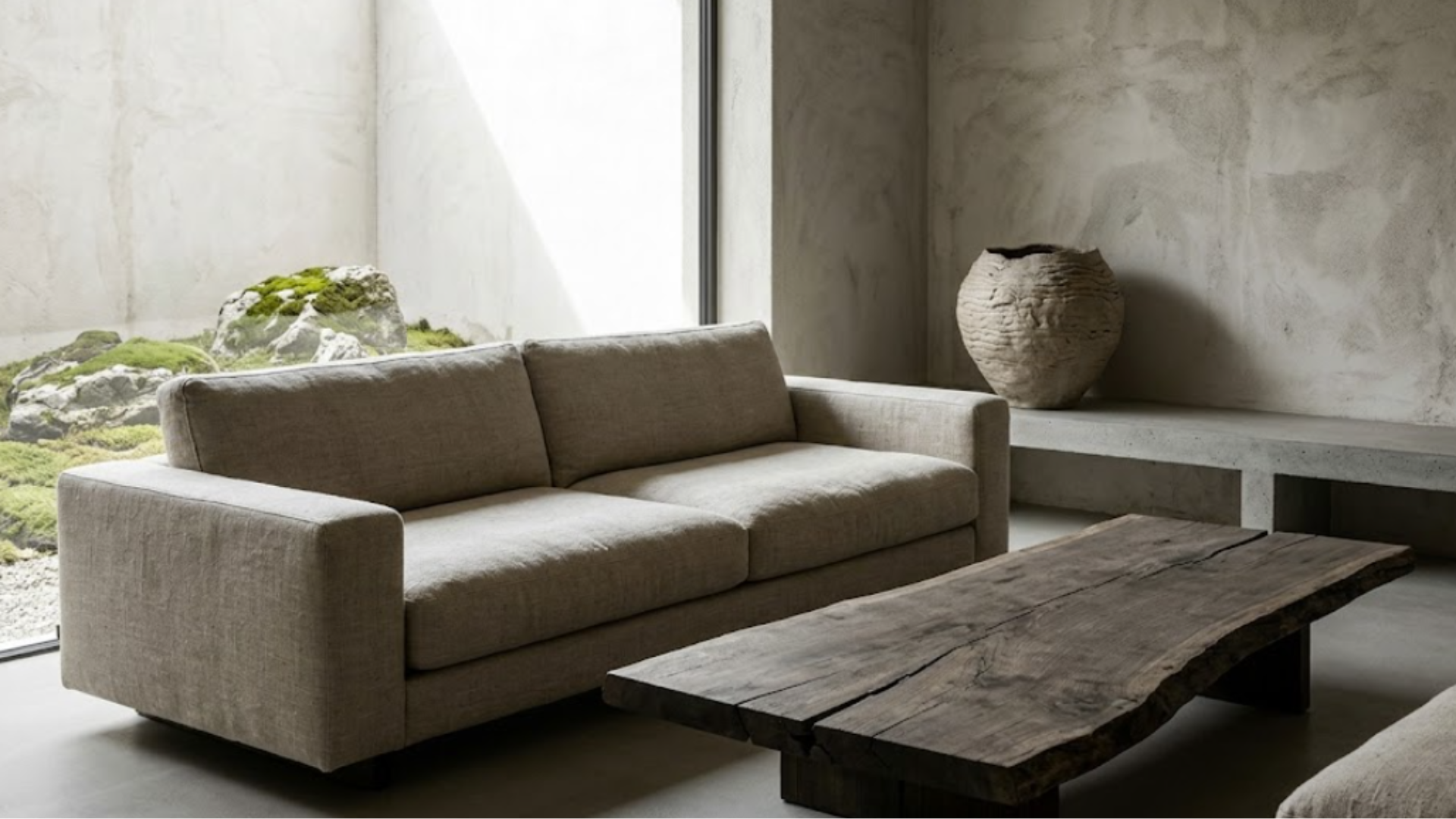
    Starting the year with a Wabi-Sabi mindset means choosing quality over quantity. Instead of a fast-furniture overhaul, consider the “Quiet Luxury” approach: investing in one piece that will age beautifully over the next twenty years. The “Quiet Luxury” aesthetic, as seen in the textured walls and organic furniture of a Wabi-Sabi-inspired room, emphasizes a palette of “earth-tones”โ€”clays, stones, and sand. These colors don’t just sit on the surface; they react to the changing light of the day, making the home feel like a living, breathing entity.

    The Architecture of Authenticity

    To bring Wabi-Sabi into the modern home, one must look at the “bones” of the space. It begins with texture. Flat, painted drywall is replaced with lime-wash or plaster, which carries the visible sweep of the artisanโ€™s hand. Synthetic fibers are swapped for heavy linens, wool, and silkโ€”materials that possess a tactile depth and a natural “give.”

    This design trend is a direct response to the “perfection fatigue” caused by social media. When every image we see is filtered and airbrushed, the physical reality of a knot in a piece of oak or a patina on a brass faucet feels refreshingly honest. This is why many top designers are leaning into Sustainable Design Practices, focusing on reclaimed materials that already carry a history within them.

    Wabi-Sabi also embraces the concept of Maโ€”the Japanese word for “negative space” or “the gap.” Itโ€™s the intentional emptiness that allows the few objects you do own to speak. A Wabi-Sabi home isn’t cluttered; it is curated. Each object is there because it serves a purpose or possesses a “silent beauty.”

    Curating the Imperfect Table

    The kitchen and dining areas are perhaps the easiest places to begin your Wabi-Sabi journey this year. Moving away from the matching 12-piece porcelain sets, we find luxury in the unique. Hand-thrown ceramics, with their subtle variations in glaze and weight, turn a mundane Tuesday night dinner into a ritual of appreciation.

    The beauty of these objects lies in their “kinship” with the earth. When you hold a bowl that feels slightly uneven, you are connected to the hands that made it and the clay it was formed from. This connection is the ultimate luxury in a world that is becoming increasingly automated.

    The act of “curating the table” is a form of daily meditation. Itโ€™s about noticing the way a linen napkin softens after every wash, or the way a wooden board darkens as it absorbs oils over time. This isn’t just about “style”; itโ€™s about a lifestyle that values the passage of time rather than fearing it.

    Intentional Living for the New Year

    As we plan our homes for the year ahead, Wabi-Sabi offers a more sustainable, peaceful alternative to the “trends” cycle. It invites us to stop “decorating” and start “inhabiting.”

    When you embrace imperfection, the pressure to maintain a “show-home” disappears. You are allowed to have a stack of books on the floor. You are allowed to have a vintage rug with a slightly frayed edge. These are not flaws; they are the “coastal echoes” of your personal history.

    In the modern home, Quiet Luxury is the ability to walk into a room and feel an immediate sense of lowered heart rate. It is the soft light hitting a textured wall, the comfort of a lived-in chair, and the quiet confidence that your home does not need to be perfect to be extraordinary.

    Conclusion

    The Art of Wabi-Sabi is a reminder that our homes are not just places to store thingsโ€”they are the containers for our lives. By choosing materials that age gracefully and objects that tell a story, we create a space that supports our well-being and reflects our true selves. This year, don’t just clear the clutter; change your relationship with the objects you keep. Find the luxury in the quiet, the beauty in the broken, and the peace in the imperfect. Now that youโ€™ve refined your physical sanctuary, explore our guide on creating a mental one through Digital Minimalism: How to Curate a More Intentional Online Life.… Read the rest

  • The Art of Slow Travel: Finding Stillness in Kyotoโ€™s Hidden Temples

    The Art of Slow Travel: Finding Stillness in Kyotoโ€™s Hidden Temples

    In our hyper-connected modern era, travel often transforms into another form of productivity. We approach new cities with checklists, driven by the anxiety of missed sights and the digital compulsion to “gram” the moment. We move quickly, collect locations, and consume cultures. But some places do not yield their secrets to the rushed traveler. They demand a different currency. But some places do not yield their secrets to the rushed traveler. They demand a different currency: patience and presence. I felt this deeply during a weekend along the rugged cliffs of Portugal, and I found it to be equally true in the heart of Japan.

    Kyoto is one such place. The former imperial capital of Japan, renowned for its thousands of classical Buddhist temples, gardens, and shrines, is facing unprecedented challenges from over-tourism. The famous bamboo groves of Arashiyama and the golden pavilion of Kinkaku-ji are beautiful, yes, but often obscured by a sea of selfie sticks.

    To truly meet Kyotoโ€”the quiet, introspective Kyoto that has inspired poets and philosophers for centuriesโ€”one must master the art of slow travel. This philosophy isn’t merely about moving slowly; it’s about shifting the focus from seeing to experiencing. Itโ€™s the difference between collecting a photograph and collecting a memory.

    This autumn, I sought that stillness. I bypassed the mainstream circuits, aiming instead for the northern, forested hills of Takao and Sakyo-ku. Here, the only itinerary is the path itself.

    The Call of Autumn: Momijigari

    The Japanese have a dedicated word for the appreciation of autumn leaves: Momijigari, or “red maple hunting.” But unlike the spring Hanami (cherry blossom viewing), which is often celebrated with lively picnics, Momijigari is inherently introspective.

    In Kyoto, autumn isn’t just a season; it’s a sensory experience that aligns perfectly with slow travel. The damp smell of cedar and decaying leaves hangs in the cool air. The light, softened by the autumn atmosphere, filters through a canopy that ranges from deep burgundy to fiery orange. The colors are so vibrant they feel almost emotional, a final, brilliant burst of life before the dormancy of winter. This environment naturally encourages a quiet, reflective mood.

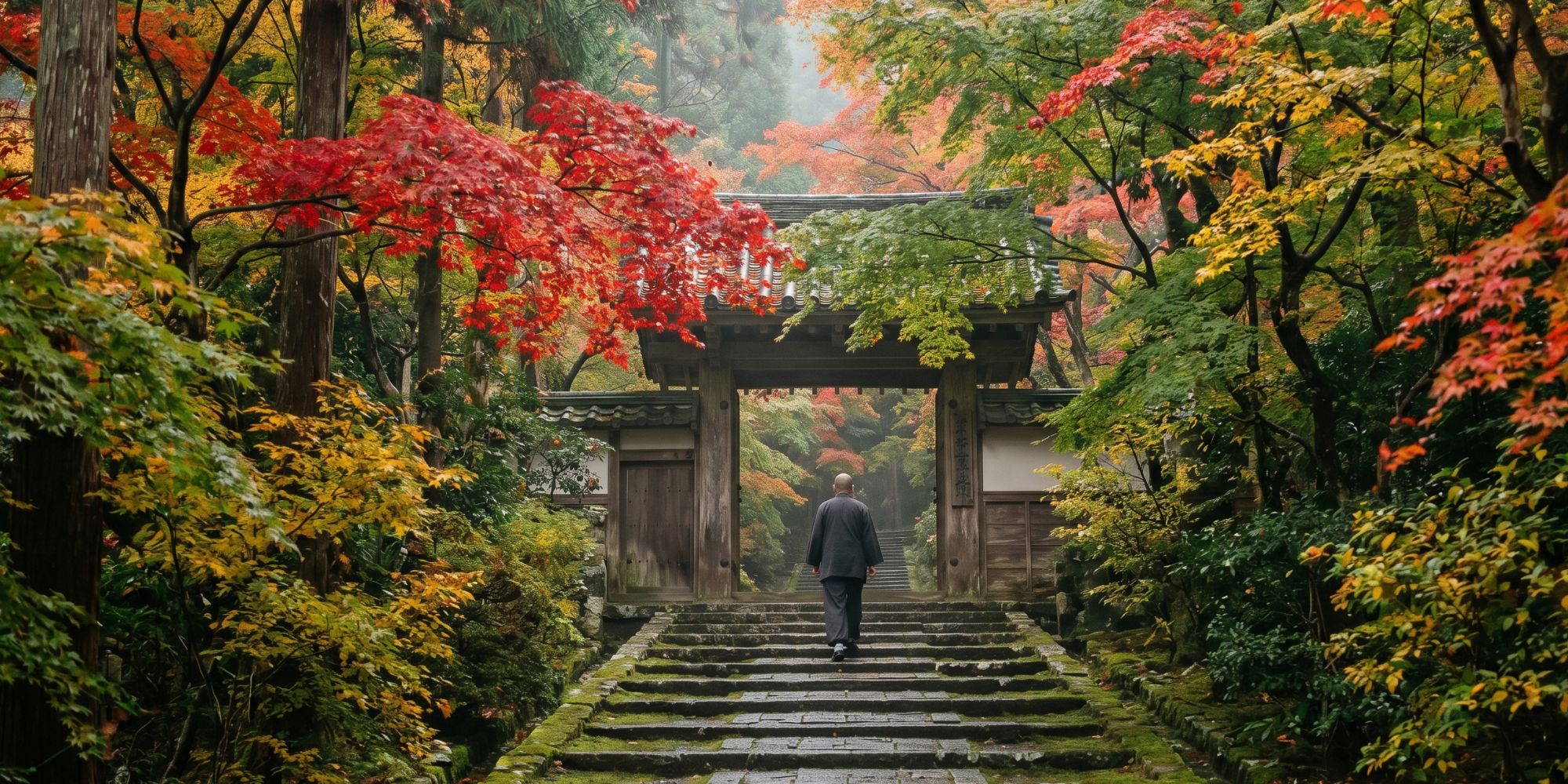
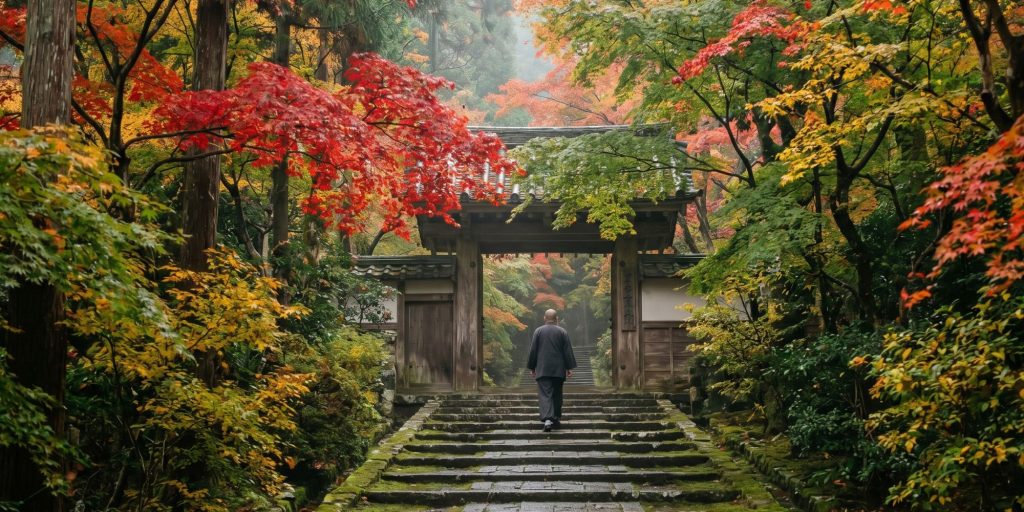
    To experience Momijigari away from the crowds, my journey led me to Jลkoji, a small temple complex tucked deep into the mountains north of the city. Jลkoji doesn’t appear on most “top ten” lists. It requires a specific effort to reach, a deliberate choice to step off the grid. As I walked the winding, mist-shrouded path, the city noise evaporated. Slow travel begins the moment you accept that the destination is the journey. The rhythm of my footsteps on the moss-covered stones became a meditation. The weathered wood of the temple, blending perfectly with the scarlet maples, whispered of age and resilience. I wasnโ€™t trying to “get there”; I was simply there.

    Ryoan-ji and the Architecture of Silence

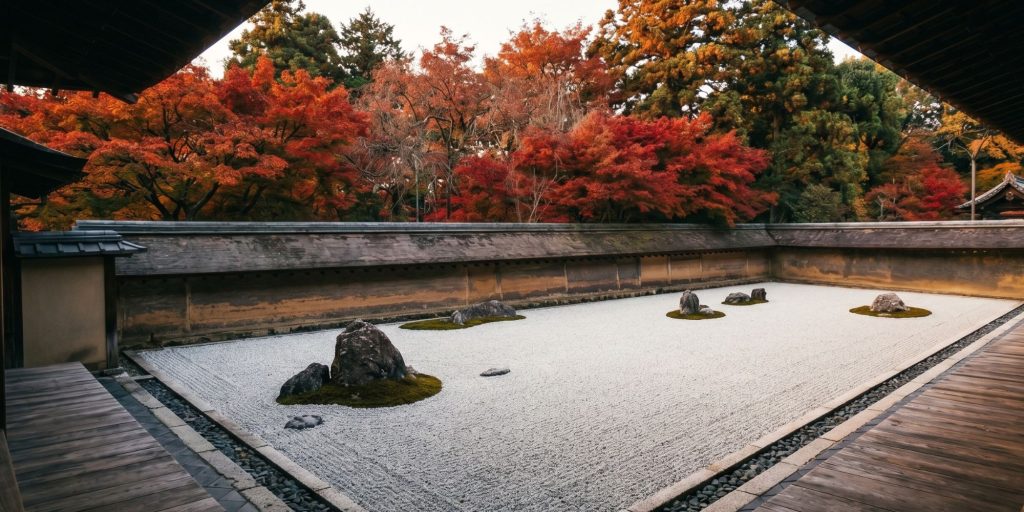
    While I sought the truly hidden gems, I realized that even well-known sites can be experienced through a slow lens if you arrive early. My next stop was the famous Ryoan-ji Temple, renowned worldwide for its minimalist dry landscape garden (Karesansui). I arrived as the gates opened, the dew still fresh on the moss.

    Most visitors stay at Ryoan-ji for twenty minutes. They see the 15 rocks arranged in a sea of raked white gravel. They try to find the angle where all 15 stones are visible simultaneously (it is designed so you can never see them all at once), take their photo, and leave. But Ryoan-ji is not meant to be looked at; it is meant to be sat with.

    Sitting on the smooth wooden engawa (veranda), I committed to staying for one hour, regardless of the temptation to move. The view was framed by the dark, heavy wooden beams of the temple roof, which seemed to ground the observer.

    The garden is a void, a blank canvas that invites the mind to settle. Zen gardens are designed not to represent a landscape, but to facilitate meditation. The Ryoan-ji Temple provides excellent context regarding the temple’s history as a Rinzai Zen site, but no text can describe the profound physical sensation of silence that accumulates as you wait.

    In that hour, the light shifted. The shadows of the autumn maples draped over the enclosing earthen wall grew longer, changing the texture of the raked gravel. I noticed the variation in the moss, the tiny imperfections in the rocks, the sound of water dripping somewhere unseen. The art of slow travel was in the discipline of not moving, of letting the environment reveal its layers to me, rather than chasing them.

    The Ritual of Presence

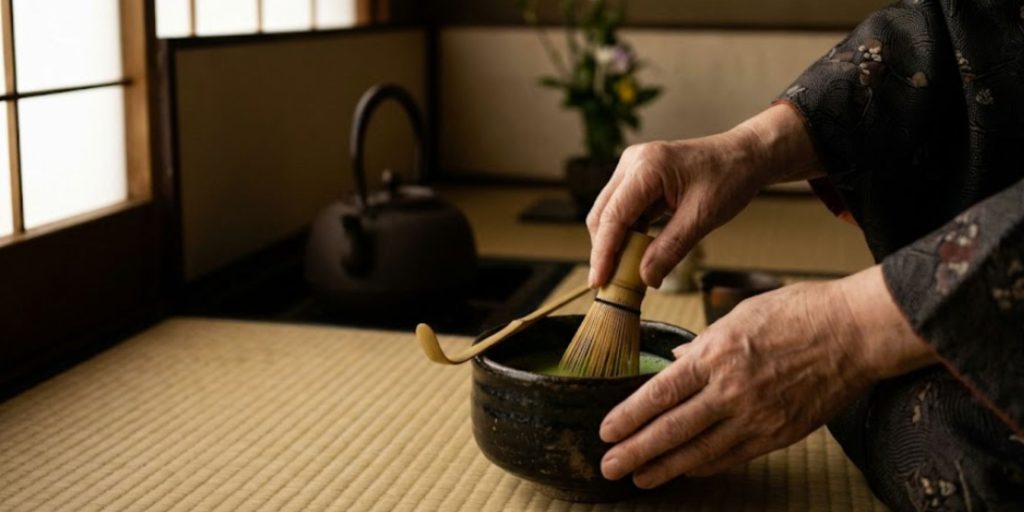
    The final, and perhaps most crucial, component of slow travel in Kyoto is the tea ceremony (chanoyu). You cannot “grab a quick coffee” and experience Kyoto culture; you must participate in the ritual of presence.

    I found my way to a private, traditional teahouse located near the less-visited Honen-in Temple. The experience was defined not by luxury, but by intentionality. The entrance required stepping through a small garden and bowing low to enter the chashitsu (tea room), an act signifying humility.

    My attention was drawn to the delicate hand of the tea host as she whisks the matcha. The action is fluid and precise, yet incredibly slow. This attention to detail is central to the concept of Wabi-Sabi (an important concept in Japanese aesthetics)โ€”the beauty of the imperfect, impermanent, and incomplete. The dark, hand-fired ceramic bowl she used, known as a chawan, was intentionally rustic, its value lying in its history and utility, not its perfection.

    The ceremony is slow travel distilled: you are asked to focus entirely on one cup of tea. For the Kyoto Tourism Association, promoting these traditional arts helps connect visitors with the cityโ€™s deeper heritage. For the traveler, it provides a crucial moment of reset. When you leave the ceremony, you do not rush to the next destination. You linger in the courtyard, appreciating the light. You move through the world differently because you have been invited into stillness.

    Conclusion

    The art of slow travel in Kyoto doesn’t ask you to avoid the main sights. It simply asks that when you visit, you give them your presence, not your productivity. It suggests that three hours spent fully engaged with one hidden temple, its architecture, and its autumn garden, is a richer travel experience than three days spent ticking 30 locations off a list.

    In the stillness of Kyotoโ€™s hidden temples, we find more than just history; we find a natural rhythm that our modern lives have forgotten. We learn that the deepest stories are often the ones that cannot be captured in a photo, but must be collected slowly, in the resonance of a memory. Kyoto is ready to reveal itself, but only to those willing to wait.… Read the rest

  • Coastal Echoes: A Weekend Spent Along the Rugged Cliffs of Portugal

    Coastal Echoes: A Weekend Spent Along the Rugged Cliffs of Portugal

    The air in southern Portugal during mid-summer possesses a particular kind of alchemy. It is thick with the scent of sun-baked rock, dry wild thyme, and the unmistakable, sharp tang of the Atlantic. Itโ€™s a heat that encourages slow movement, long lunches, and an acceptance that the ocean, not the clock, dictates the rhythm of the day.

    This weekend, I escaped the managed chaos of the inland resorts for the Costa Vicentina, the rugged southwestern coast that remains, thankfully, wild. This isn’t the manicured Algarve of postcard fame; this is Portugalโ€™s dramatic, raw frontier, where massive schist and limestone cliffs plunge violently into a turquoise sea that seems far too energetic for the July heat.

    My objective was simple: to connect with the landscape rather than merely consume it. I wanted to hear the “coastal echoes”โ€”the sounds of the wind carving stone, the crash of Atlantic rollers, and the quiet rhythm of ancient fishing villages. This trip was less a rigid itinerary and more a series of observant momentsโ€”a continuation of the philosophy I explored while finding stillness in Kyotoโ€™s hidden templesโ€”strung together like sea glass on a shoreline.

    The Edge of the Continent: Sagres and Cabo de Sรฃo Vicente

    To begin any journey along Portugalโ€™s wild coast, one must travel as far west and south as possible. I started in Sagres, a town defined not by its architecture, but by its geography. Sagres sits on a windswept peninsula, a place where the land seems to hold its breath before surrendering to the sea.

    Historically, this was known as Promontorium Sacrum (Sacred Promontory) to the Romans, and later, it was famously associated with Prince Henry the Navigator and his school of navigation during the Age of Discovery. Walking around the massive Sagres Fortress, a structure that feels more like an extension of the cliff face than a human construction, you feel that history not in dates, but in the environment. The wind here is relentless. It shapes the hardy, low-lying scrub brush and seems to cleanse the landscape of anything superfluous.

    Just a short drive away lies Cabo de Sรฃo Vicente (Cape St. Vincent), the southwesternmost point of Europe. If Sagres is the edge, this is the end. The cliffs here (visible in the distant headland) rise 75 meters almost vertically from the Atlantic. Perched on this precipice is one of Europeโ€™s most powerful lighthouses. Standing at the base of the tower, watching the white foam explode against the golden-orange rock, I felt incredibly small. This, the official Visit Portugal guide notes, was considered the end of the known world for centuries. Today, even with the presence of a few other visitors, that sense of existential scale remains unmuted.

    I walked a dirt path that hugged the cliff edge, where dry tawny grasses and vibrant green scrub provide the only buffer between you and the deep blue abyss. The warm daylight caught the sparkling water far below. It was a place of dramatic stillness, where the view demands you pause and listen to the relentless erosion of the continent.

    Walking the Rota Vicentina

    The true magic of this coastline is revealed by leaving the car behind and walking. The Costa Vicentina is protected within the Parque Natural do Sudoeste Alentejano e Costa Vicentina, a massive natural park that ensures this rugged beauty remains untouched by large-scale development.

    Connecting these cliffs and villages is the Rota Vicentina, a network of walking trails that are fast becoming legendary among European hikers. The most iconic section is the “Fishermenโ€™s Trail,” which often follows the exact paths local fishermen use to reach secret, precarious angling spots on the cliff faces.

    I spent my Saturday walking a breathtaking section north of Odeceixe. The trail wound through aromatic scrub land before emerging onto the massive, undulating cliff tops that are the extension of the geology seen further south. Here, as captured, two hikers move along a narrow, sandy path. The bright mid-summer sun makes the hazy, turquoise Atlantic sparkle. From this height, a vast, secluded golden sand beach is visible far below, with surfers appearing as tiny dots in the powerful white waves crashing at the cliff base.

    Walking this trail is a masterclass in coastal ecology. You walk through dense, resilient wild thyme, juniper, and rockrose, the dry ground releasing aromatic oils under the hot sun. The wind here is constant, a refreshing brine that keeps the summer heat manageable. The Rota Vicentina isn’t a challenge; itโ€™s a meditation. Each turn in the path reveals a new perspective of the coastlineโ€”a hidden cove, a sea stack carved into an improbable arch, or an endless vista of the deep Atlantic.

    The Quiet Rhythm of the Villages

    The weekends on the Costa Vicentina arenโ€™t exclusively defined by dramatic scale. They are also defined by the breezy charm of the villages that huddle behind the dunes or in the river valleys. Towns like Odeceixe, Aljezur, and Zambujeira do Mar offer a quiet, authentic counterpart to the coastal intensity.

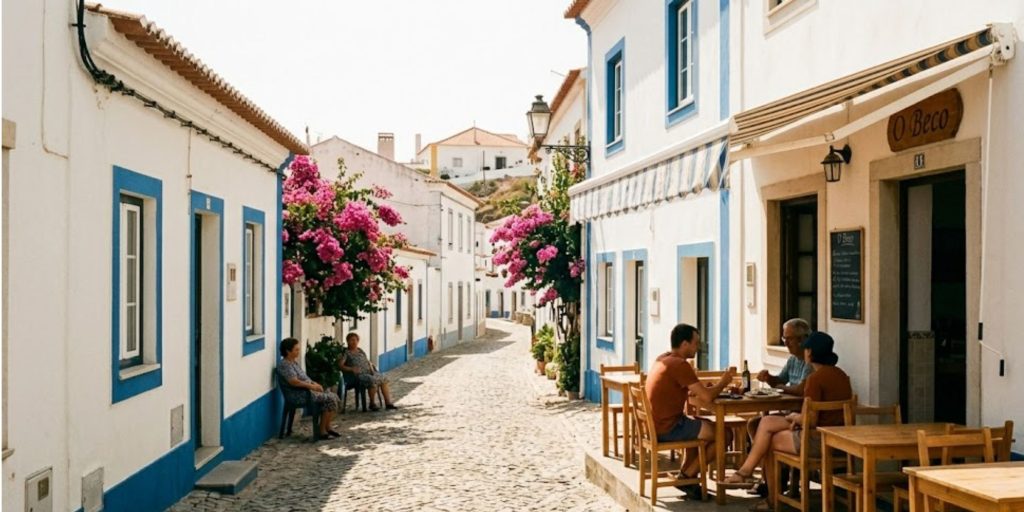
    In the mid-day heat, these villages seem to observe a gentle pause. The scene captured shows the narrow, curving cobblestone street of a small fishing village, consistent with the Alentejo region. The whitewashed houses, often trimmed in vibrant blue, seem to radiate the hazy, warm summer light. A burst of bougainvillea provides a saturated counterpoint to the neutral stone.

    I stopped at a casual open-air cafe called ‘O Beco,’ where simple wooden tables are shaded by a striped awning. Here, I joined a few locals (and perhaps another hiker who had also left the high trails) to enjoy a simple, excellent meal of grilled sardines and a crisp white wine.

    The vibe here is observatory. You watch the older residents move slowly from shade to shade, you listen to the rhythmic call and response of Fado drifting from a distant window, and you appreciate the lack of urgency. The coffee is strong, the conversation is slow, and the ocean is always just a few streets away, its distant crash providing the base note to the village soundtrack.

    Conclusion

    A weekend on the rugged cliffs of Portugal is an exercise in recalibration. Itโ€™s a place where the Atlantic wind blows away the mental clutter of modern life. The Costa Vicentina offers a rare opportunity to connect with a landscape that remains unapologetically wild. From the windswept scale of Cabo de Sรฃo Vicente to the intimate, cobblestone stillness of its villages, this coast reminds us that true travel is often about presence, not productivity. We leave with the coastal echoes lingeringโ€”a memory of sun, salt, and the art of slowing down.… Read the rest