
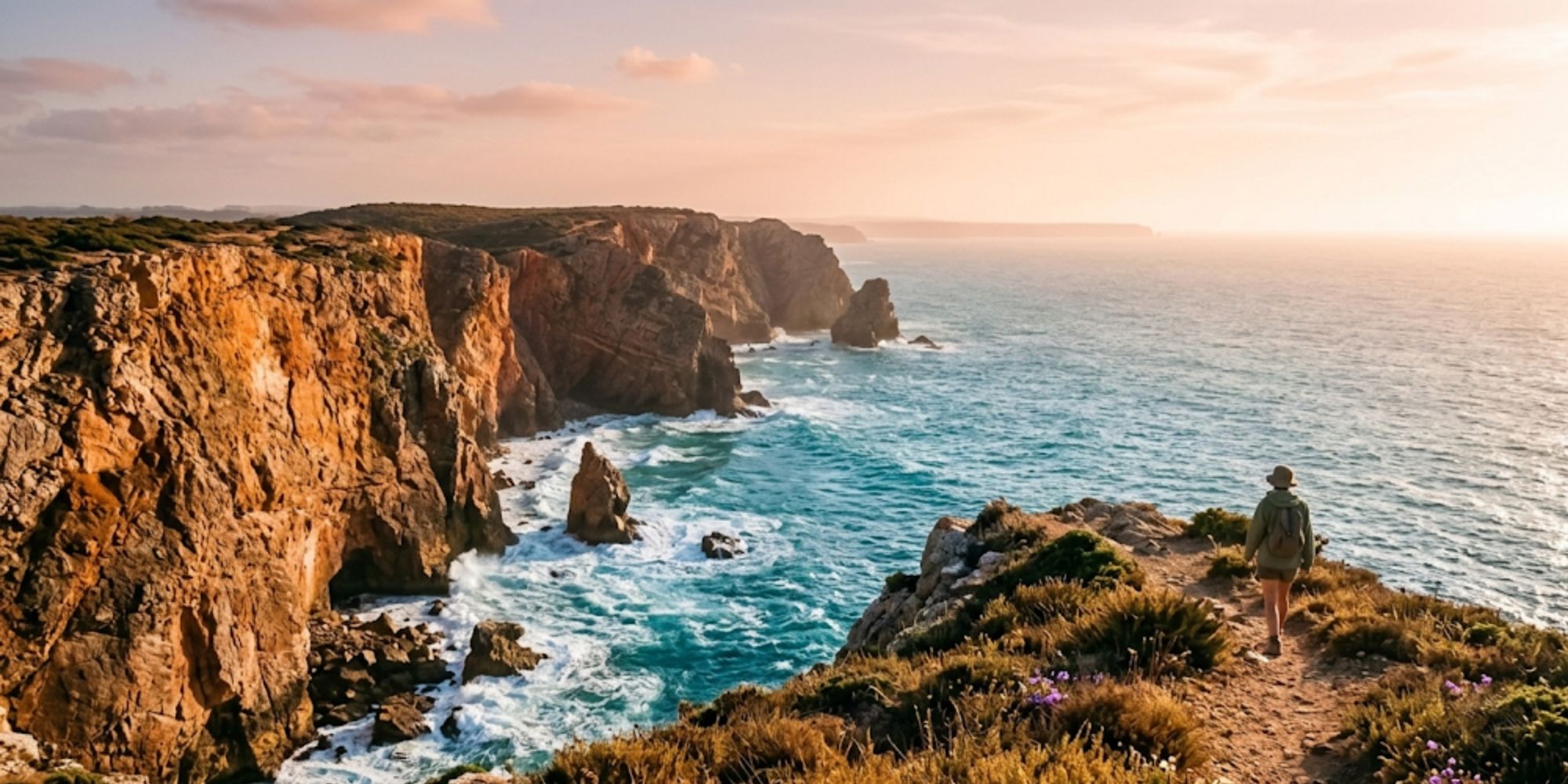
The air in southern Portugal during mid-summer possesses a particular kind of alchemy. It is thick with the scent of sun-baked rock, dry wild thyme, and the unmistakable, sharp tang of the Atlantic. It’s a heat that encourages slow movement, long lunches, and an acceptance that the ocean, not the clock, dictates the rhythm of the day.
This weekend, I escaped the managed chaos of the inland resorts for the Costa Vicentina, the rugged southwestern coast that remains, thankfully, wild. This isn’t the manicured Algarve of postcard fame; this is Portugal’s dramatic, raw frontier, where massive schist and limestone cliffs plunge violently into a turquoise sea that seems far too energetic for the July heat.
My objective was simple: to connect with the landscape rather than merely consume it. I wanted to hear the “coastal echoes”—the sounds of the wind carving stone, the crash of Atlantic rollers, and the quiet rhythm of ancient fishing villages. This trip was less a rigid itinerary and more a series of observant moments—a continuation of the philosophy I explored while finding stillness in Kyoto’s hidden temples—strung together like sea glass on a shoreline.
The Edge of the Continent: Sagres and Cabo de São Vicente
To begin any journey along Portugal’s wild coast, one must travel as far west and south as possible. I started in Sagres, a town defined not by its architecture, but by its geography. Sagres sits on a windswept peninsula, a place where the land seems to hold its breath before surrendering to the sea.
Historically, this was known as Promontorium Sacrum (Sacred Promontory) to the Romans, and later, it was famously associated with Prince Henry the Navigator and his school of navigation during the Age of Discovery. Walking around the massive Sagres Fortress, a structure that feels more like an extension of the cliff face than a human construction, you feel that history not in dates, but in the environment. The wind here is relentless. It shapes the hardy, low-lying scrub brush and seems to cleanse the landscape of anything superfluous.
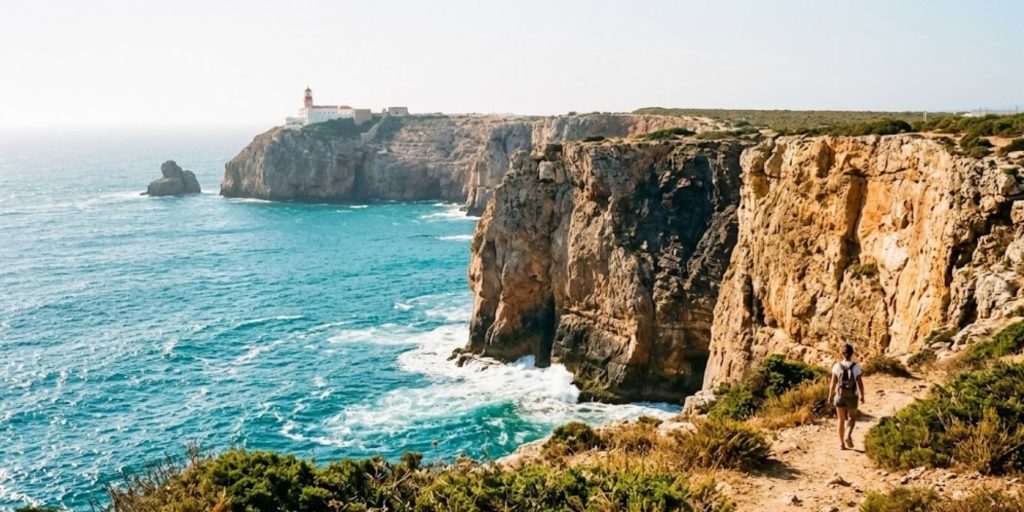
Just a short drive away lies Cabo de São Vicente (Cape St. Vincent), the southwesternmost point of Europe. If Sagres is the edge, this is the end. The cliffs here (visible in the distant headland) rise 75 meters almost vertically from the Atlantic. Perched on this precipice is one of Europe’s most powerful lighthouses. Standing at the base of the tower, watching the white foam explode against the golden-orange rock, I felt incredibly small. This, the official Visit Portugal guide notes, was considered the end of the known world for centuries. Today, even with the presence of a few other visitors, that sense of existential scale remains unmuted.
I walked a dirt path that hugged the cliff edge, where dry tawny grasses and vibrant green scrub provide the only buffer between you and the deep blue abyss. The warm daylight caught the sparkling water far below. It was a place of dramatic stillness, where the view demands you pause and listen to the relentless erosion of the continent.
Walking the Rota Vicentina
The true magic of this coastline is revealed by leaving the car behind and walking. The Costa Vicentina is protected within the Parque Natural do Sudoeste Alentejano e Costa Vicentina, a massive natural park that ensures this rugged beauty remains untouched by large-scale development.
Connecting these cliffs and villages is the Rota Vicentina, a network of walking trails that are fast becoming legendary among European hikers. The most iconic section is the “Fishermen’s Trail,” which often follows the exact paths local fishermen use to reach secret, precarious angling spots on the cliff faces.
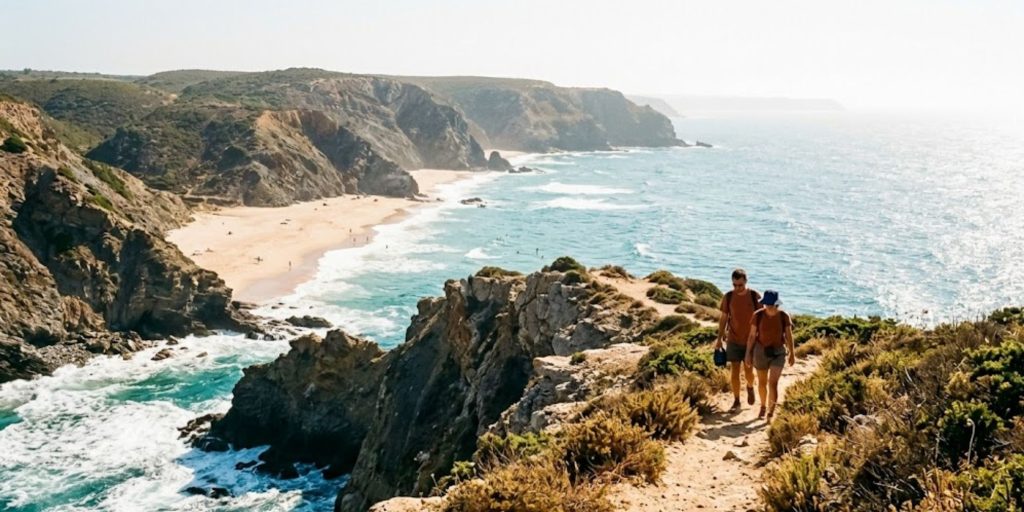
I spent my Saturday walking a breathtaking section north of Odeceixe. The trail wound through aromatic scrub land before emerging onto the massive, undulating cliff tops that are the extension of the geology seen further south. Here, as captured, two hikers move along a narrow, sandy path. The bright mid-summer sun makes the hazy, turquoise Atlantic sparkle. From this height, a vast, secluded golden sand beach is visible far below, with surfers appearing as tiny dots in the powerful white waves crashing at the cliff base.
Walking this trail is a masterclass in coastal ecology. You walk through dense, resilient wild thyme, juniper, and rockrose, the dry ground releasing aromatic oils under the hot sun. The wind here is constant, a refreshing brine that keeps the summer heat manageable. The Rota Vicentina isn’t a challenge; it’s a meditation. Each turn in the path reveals a new perspective of the coastline—a hidden cove, a sea stack carved into an improbable arch, or an endless vista of the deep Atlantic.
The Quiet Rhythm of the Villages
The weekends on the Costa Vicentina aren’t exclusively defined by dramatic scale. They are also defined by the breezy charm of the villages that huddle behind the dunes or in the river valleys. Towns like Odeceixe, Aljezur, and Zambujeira do Mar offer a quiet, authentic counterpart to the coastal intensity.
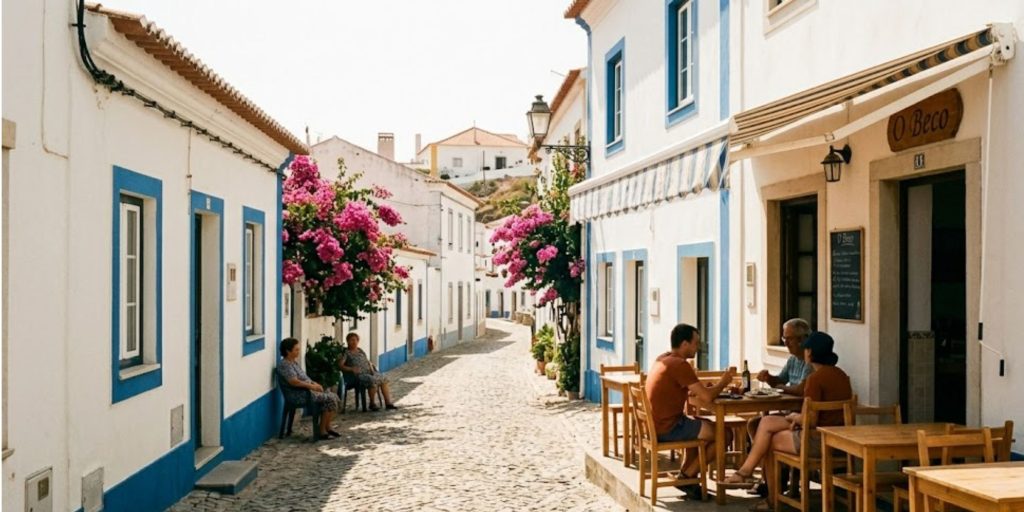
In the mid-day heat, these villages seem to observe a gentle pause. The scene captured shows the narrow, curving cobblestone street of a small fishing village, consistent with the Alentejo region. The whitewashed houses, often trimmed in vibrant blue, seem to radiate the hazy, warm summer light. A burst of bougainvillea provides a saturated counterpoint to the neutral stone.
I stopped at a casual open-air cafe called ‘O Beco,’ where simple wooden tables are shaded by a striped awning. Here, I joined a few locals (and perhaps another hiker who had also left the high trails) to enjoy a simple, excellent meal of grilled sardines and a crisp white wine.
The vibe here is observatory. You watch the older residents move slowly from shade to shade, you listen to the rhythmic call and response of Fado drifting from a distant window, and you appreciate the lack of urgency. The coffee is strong, the conversation is slow, and the ocean is always just a few streets away, its distant crash providing the base note to the village soundtrack.
Conclusion
A weekend on the rugged cliffs of Portugal is an exercise in recalibration. It’s a place where the Atlantic wind blows away the mental clutter of modern life. The Costa Vicentina offers a rare opportunity to connect with a landscape that remains unapologetically wild. From the windswept scale of Cabo de São Vicente to the intimate, cobblestone stillness of its villages, this coast reminds us that true travel is often about presence, not productivity. We leave with the coastal echoes lingering—a memory of sun, salt, and the art of slowing down.
Leave a Reply