
In our hyper-connected modern era, travel often transforms into another form of productivity. We approach new cities with checklists, driven by the anxiety of missed sights and the digital compulsion to “gram” the moment. We move quickly, collect locations, and consume cultures. But some places do not yield their secrets to the rushed traveler. They demand a different currency. But some places do not yield their secrets to the rushed traveler. They demand a different currency: patience and presence. I felt this deeply during a weekend along the rugged cliffs of Portugal, and I found it to be equally true in the heart of Japan.
Kyoto is one such place. The former imperial capital of Japan, renowned for its thousands of classical Buddhist temples, gardens, and shrines, is facing unprecedented challenges from over-tourism. The famous bamboo groves of Arashiyama and the golden pavilion of Kinkaku-ji are beautiful, yes, but often obscured by a sea of selfie sticks.
To truly meet Kyoto—the quiet, introspective Kyoto that has inspired poets and philosophers for centuries—one must master the art of slow travel. This philosophy isn’t merely about moving slowly; it’s about shifting the focus from seeing to experiencing. It’s the difference between collecting a photograph and collecting a memory.
This autumn, I sought that stillness. I bypassed the mainstream circuits, aiming instead for the northern, forested hills of Takao and Sakyo-ku. Here, the only itinerary is the path itself.
The Call of Autumn: Momijigari
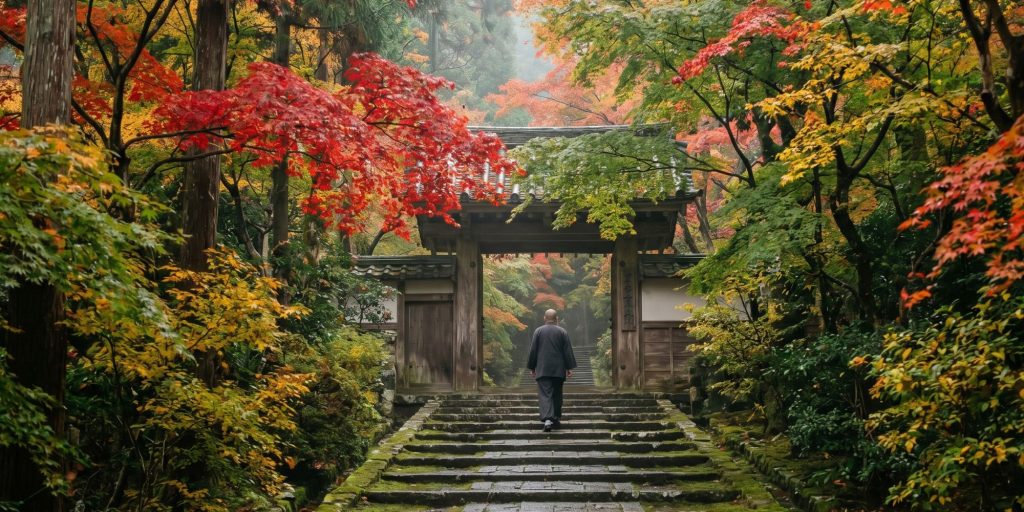
The Japanese have a dedicated word for the appreciation of autumn leaves: Momijigari, or “red maple hunting.” But unlike the spring Hanami (cherry blossom viewing), which is often celebrated with lively picnics, Momijigari is inherently introspective.
In Kyoto, autumn isn’t just a season; it’s a sensory experience that aligns perfectly with slow travel. The damp smell of cedar and decaying leaves hangs in the cool air. The light, softened by the autumn atmosphere, filters through a canopy that ranges from deep burgundy to fiery orange. The colors are so vibrant they feel almost emotional, a final, brilliant burst of life before the dormancy of winter. This environment naturally encourages a quiet, reflective mood.
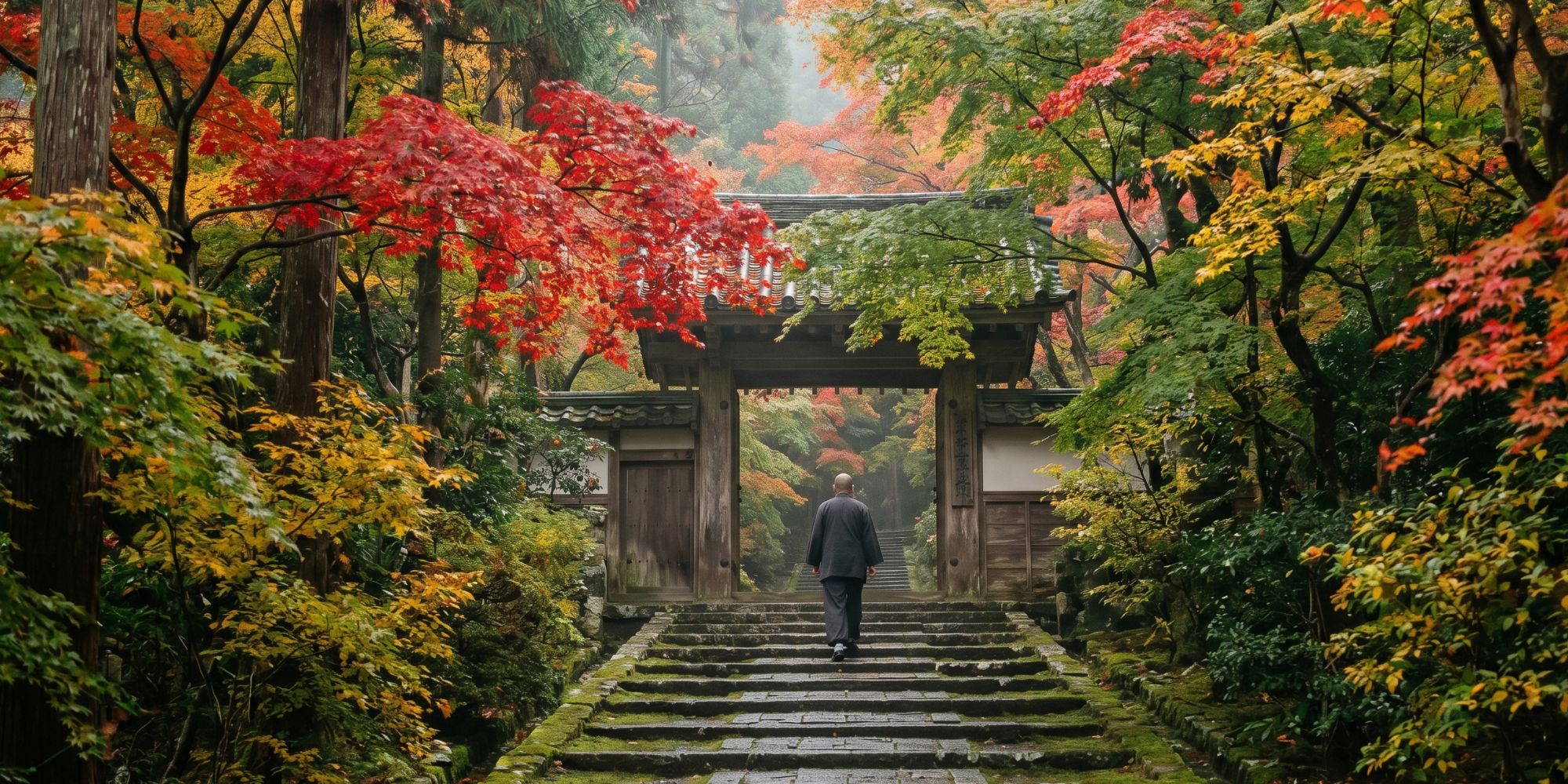
To experience Momijigari away from the crowds, my journey led me to Jōkoji, a small temple complex tucked deep into the mountains north of the city. Jōkoji doesn’t appear on most “top ten” lists. It requires a specific effort to reach, a deliberate choice to step off the grid. As I walked the winding, mist-shrouded path, the city noise evaporated. Slow travel begins the moment you accept that the destination is the journey. The rhythm of my footsteps on the moss-covered stones became a meditation. The weathered wood of the temple, blending perfectly with the scarlet maples, whispered of age and resilience. I wasn’t trying to “get there”; I was simply there.
Ryoan-ji and the Architecture of Silence
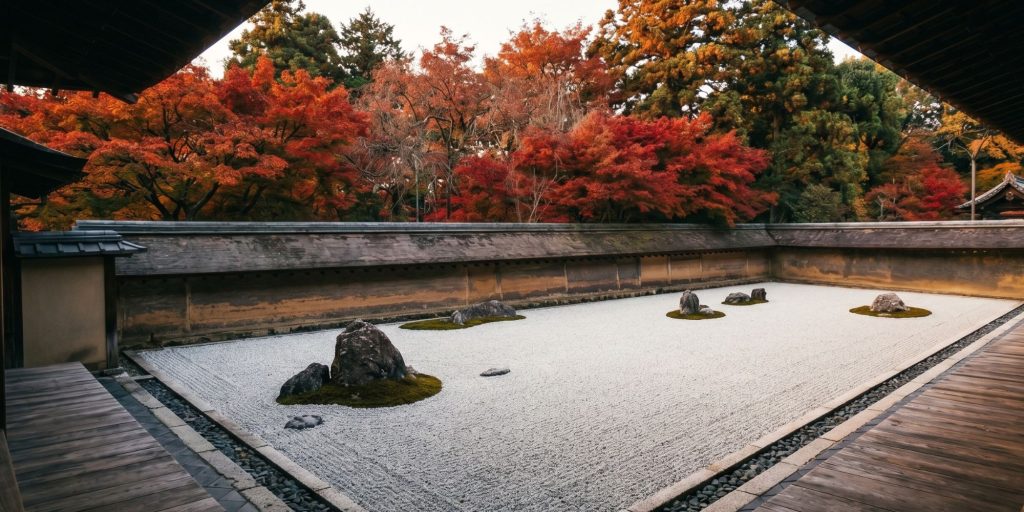
While I sought the truly hidden gems, I realized that even well-known sites can be experienced through a slow lens if you arrive early. My next stop was the famous Ryoan-ji Temple, renowned worldwide for its minimalist dry landscape garden (Karesansui). I arrived as the gates opened, the dew still fresh on the moss.
Most visitors stay at Ryoan-ji for twenty minutes. They see the 15 rocks arranged in a sea of raked white gravel. They try to find the angle where all 15 stones are visible simultaneously (it is designed so you can never see them all at once), take their photo, and leave. But Ryoan-ji is not meant to be looked at; it is meant to be sat with.
Sitting on the smooth wooden engawa (veranda), I committed to staying for one hour, regardless of the temptation to move. The view was framed by the dark, heavy wooden beams of the temple roof, which seemed to ground the observer.
The garden is a void, a blank canvas that invites the mind to settle. Zen gardens are designed not to represent a landscape, but to facilitate meditation. The Ryoan-ji Temple provides excellent context regarding the temple’s history as a Rinzai Zen site, but no text can describe the profound physical sensation of silence that accumulates as you wait.
In that hour, the light shifted. The shadows of the autumn maples draped over the enclosing earthen wall grew longer, changing the texture of the raked gravel. I noticed the variation in the moss, the tiny imperfections in the rocks, the sound of water dripping somewhere unseen. The art of slow travel was in the discipline of not moving, of letting the environment reveal its layers to me, rather than chasing them.
The Ritual of Presence
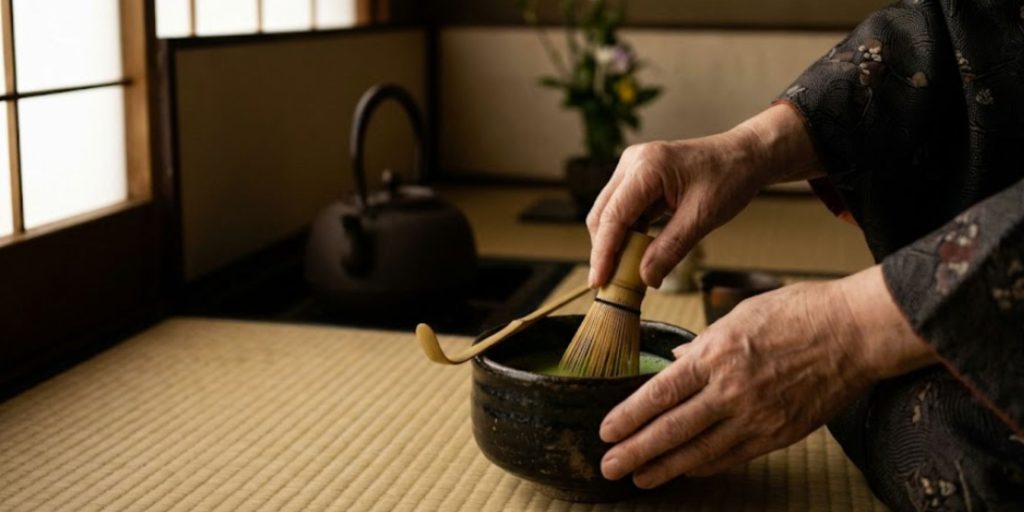
The final, and perhaps most crucial, component of slow travel in Kyoto is the tea ceremony (chanoyu). You cannot “grab a quick coffee” and experience Kyoto culture; you must participate in the ritual of presence.
I found my way to a private, traditional teahouse located near the less-visited Honen-in Temple. The experience was defined not by luxury, but by intentionality. The entrance required stepping through a small garden and bowing low to enter the chashitsu (tea room), an act signifying humility.
My attention was drawn to the delicate hand of the tea host as she whisks the matcha. The action is fluid and precise, yet incredibly slow. This attention to detail is central to the concept of Wabi-Sabi (an important concept in Japanese aesthetics)—the beauty of the imperfect, impermanent, and incomplete. The dark, hand-fired ceramic bowl she used, known as a chawan, was intentionally rustic, its value lying in its history and utility, not its perfection.
The ceremony is slow travel distilled: you are asked to focus entirely on one cup of tea. For the Kyoto Tourism Association, promoting these traditional arts helps connect visitors with the city’s deeper heritage. For the traveler, it provides a crucial moment of reset. When you leave the ceremony, you do not rush to the next destination. You linger in the courtyard, appreciating the light. You move through the world differently because you have been invited into stillness.
Conclusion
The art of slow travel in Kyoto doesn’t ask you to avoid the main sights. It simply asks that when you visit, you give them your presence, not your productivity. It suggests that three hours spent fully engaged with one hidden temple, its architecture, and its autumn garden, is a richer travel experience than three days spent ticking 30 locations off a list.
In the stillness of Kyoto’s hidden temples, we find more than just history; we find a natural rhythm that our modern lives have forgotten. We learn that the deepest stories are often the ones that cannot be captured in a photo, but must be collected slowly, in the resonance of a memory. Kyoto is ready to reveal itself, but only to those willing to wait.
Leave a Reply